

















Theme 2 - Unequal Integration and Unequal Development in a Globalised World
Publié le 26/04/2026
Extrait du document
«
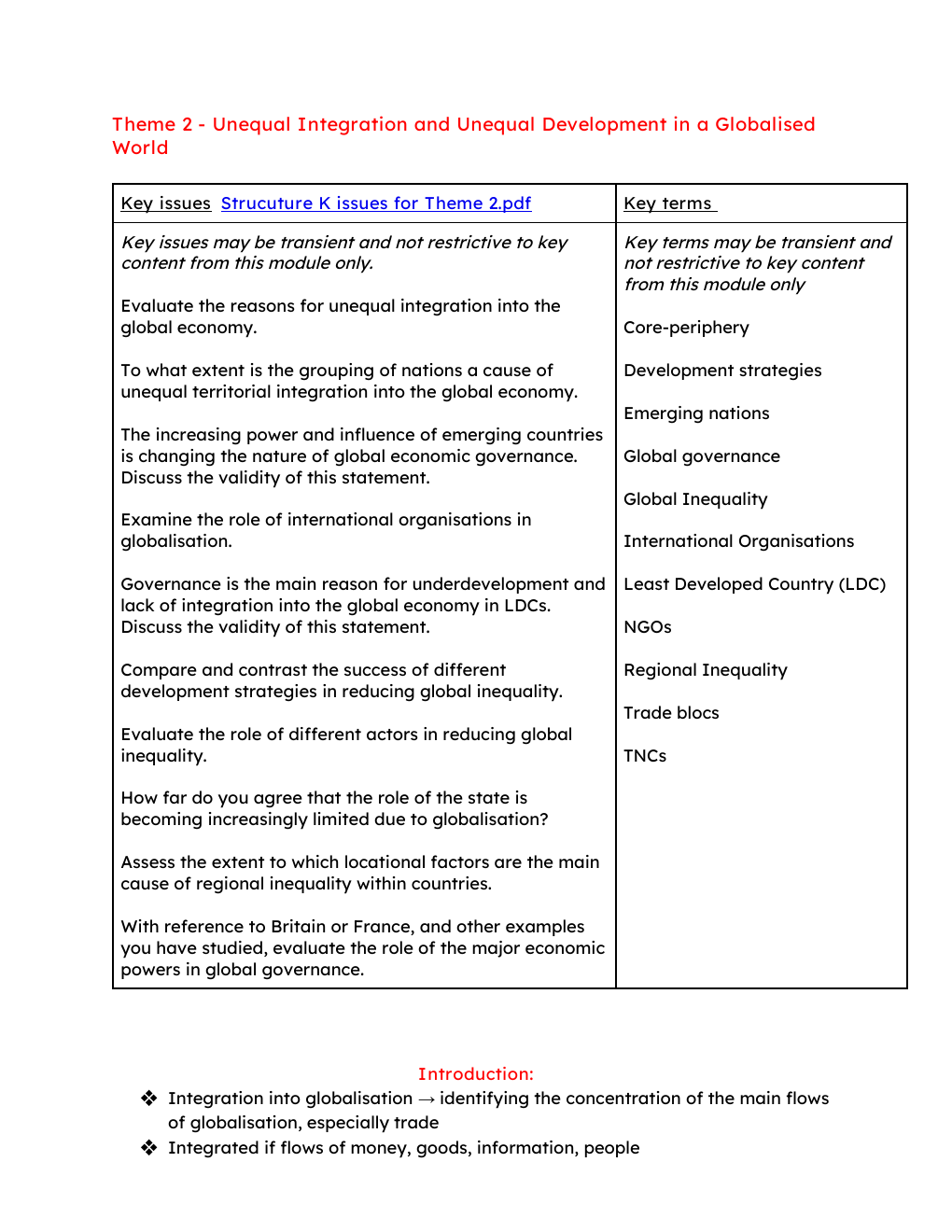
Theme 2 - Unequal Integration and Unequal Development in a Globalised
World
Key issues Strucuture K issues for Theme 2.pdf
Key terms
Key issues may be transient and not restrictive to key
content from this module only.
Key terms may be transient and
not restrictive to key content
from this module only
Evaluate the reasons for unequal integration into the
global economy.
To what extent is the grouping of nations a cause of
unequal territorial integration into the global economy.
The increasing power and influence of emerging countries
is changing the nature of global economic governance.
Discuss the validity of this statement.
Examine the role of international organisations in
globalisation.
Core-periphery
Development strategies
Emerging nations
Global governance
Global Inequality
International Organisations
Governance is the main reason for underdevelopment and
lack of integration into the global economy in LDCs.
Discuss the validity of this statement.
Least Developed Country (LDC)
Compare and contrast the success of different
development strategies in reducing global inequality.
Regional Inequality
Evaluate the role of different actors in reducing global
inequality.
NGOs
Trade blocs
TNCs
How far do you agree that the role of the state is
becoming increasingly limited due to globalisation?
Assess the extent to which locational factors are the main
cause of regional inequality within countries.
With reference to Britain or France, and other examples
you have studied, evaluate the role of the major economic
powers in global governance.
Introduction:
❖ Integration into globalisation → identifying the concentration of the main flows
of globalisation, especially trade
❖ Integrated if flows of money, goods, information, people
❖ Development Gap: why some countries develop while other remain
underdeveloped
Main actors of globalisation:
❖ TNCs
❖ International organisations (UN, WTO, IMF, G20)
❖ Governments
❖ Trade blocs
Emerging economies → dispersion of global trade
❖ Regional trade agreements ex: MERCOSUR, afCFTA → increased trade
❖ Strong economic growth (TNCs + global banks) in certain groupings of
countries → BRICS, Mint Economies(Mexico, Indonesia, Nigeria and Turkey) ,
the “Next Eleven”
New actors → NICs + gulf states(Arabian and Persian gulfs; Qatar, Saudi Arabia, UAE)
⇒ Pb of integration → countries in the periphery → lack of integration and
development
Solutions to improve levels of development and reduce unequal integration ?
❖ Becoming an NIC →not possible bc not all countries benefit from the same
advantages as NICs:
➢ ➕ infrastructure
➢ high levels and investment in education
➢ FDI from Japan and USA
➢ ➕ geostrategic position
❖ Setting up of SEZs (=Special Economic Zones) → attract FDIs from TNCs by
modelling the rules → how China developed (reducing environmental laws)
INTEGRATION ≠ DEVELOPMENT
Integration into the global economy:
❖ can develop the economy
❖ can help social welfare increase (distributing economic benefits across different
social groups)
❖ but cannot (usually) improve environmental protection
How to increase integration into globalisation?
❖ Increase trade (main way)
❖ promote tourism (eg Madagascar, Nepal)
❖ facilitate flows of information (Rwanda, Africa’s tech-hub)
⇒ To increase trade
❖ reduce trade barriers by following a laissez-faire economic policy
❖ set up SEZ (eg Shenzhen)
❖ industrialise (EOI or ISI)
ISI (import substitute industrialisation): limits the import of manufactured goods and
increases domestic production of these goods (still often exporting though)
⇒ an economy can be both ISI and EOI
Colonial Britain: used ISI
India: =using ISI in SEZs
(Main tactic used in the past: start with ISI and then start exporting / outsourcing.)
Globalised economy relies on NIDL + comparative advantages
⇒ ISI does not work.
Part 1 -Disparities in development at international level
Development = a multi-strand process improvement in
quality of life and standard of living
Development encompasses: social, cultural, environmental
and political factors
Sustainable development = development that meets the needs of the present without
compromising the ability of future generations to meet their own needs.
3 main pillars
→
Countries have ≠ level of integration to globalisation
bc ≠ level of development
Measuring Development.pdf Development_what_and_how_measured.pdf
How to measure development ?
● Standard of living → economics, money, wealth (GDP)
● Quality of life → related to wealth + social and environmental factors → health
and education (HDI) → a person’s well-being and happiness
Indexes of economic development:
❖ GDP per capita = total value of goods and services produced by a country in 1
year and dividing it by the population of the country
❖ GNI per capita = GDP per capita + income received from overseas investments
(remittances, FDI, overseas factories) → more global economic index
⇒ disadvantage bc = average ⇒ inequalities ❌ considered
⇒ can = adjusted →take into account purchasing power parity (PPP) = cost → living
⇒ useful bc help → compare economic levels of development in ≠ countries
⇒➖ bc only economics side, ❌ show disparities, ❌ take into account informal sector
Indexes → social development:
❖ HDI (=Human Development Index) = measures
the quality of life
➢ Standard of living → GNI per capita
➢ Education → mean+ expected years of
schooling
➢ Health → life expectancy at birth
❖ IHDI (=Inequality Adjusted Human
Development Index)
❖ Gini coefficient = inequalities of wealth or
income within a country
Classifying countries: ordre décroissant:
HICs > oil rich countries > MIEs > NICs > NEEs > Centrally Planned Economies > LIEs >
LDCs > LLDCs
The north south ➗ has become development gap
Development Continuum = fact that countries can move from one category to another
Measuring gender equality:
❖ GEM (Gender Empowerment Measure)
❖ GDI (Gender-related Development Index)
Other
❖
❖
❖
useful indexes → development:
Infant mortality rates
Education – esp.
female literacy (important to women’s empowerment)
Nutrition – malnutrition , undernourishment
Three Gorges Dam has greatly benefited chinese economy but has had negative
effects on the people + the environment
( displaced people + pollution + less rice + flooding issues )
How UN measures development:
❖ Human Assets (HAI: Human Assets Index)
❖ Economic vulnerability (EVI: Economic and environmental vulnerability index)
❖ Income (GNI per capita)
Part 2: Causes of lack of integration into the global economy
A) Least Developed Countries (LDCs)
46 LDCs ← can be either LIEs or MIEs
Underdevelopment_doublespread.pdf
Why is there such a development gap ?
3 features of an LDC:
● Low levels of Human Assets (based on indicators of nutrition, health, education
and adult literacy)
● Economic and environmental vulnerability (based on instability of agricultural
production, % of agriculture, hunting forestry and fishing in GDP, instability of
exports of goods and services, % of population in low-lying coastal areas)
landlocked country + no economic variety
● Income (three-year average GNI per capita of less than US $1018, which must
exceed $1,306 to leave the list)
Being an LDC gives exclusive access to support (economic, against climate change,
technical aid)
What makes LDCs?
Physical geography:
● LLDC = Landlocked Developing country ⇒ they suffer from remoteness and
isolation from world markets.
Any trade using maritime routes depends on
transit through other countries.
This increases the costs of transport and can be
politically complex.
● Small island countries → remoteness and climate vulnerability
(ex:
Comoros)
● Tropical regions w extreme climatic conditions (ex: sahel region w
●
●
desertification, drought )
○ Monoculture = growing only 1 crop = high risks → unproductive farming
■ Need → diversify agriculture production and economy
Terrain
○ flat(bangladesh) ≠ mountainous (nepal)
○ Low lying = close to the sea (ex: netherlands, bangladesh)
Advantage = abundant natural resources → drive economic growth
○ But in Nigeria abundant oil but high poverty rate bc greater disparities
⇒ natural resource curse
Economic policies and political situation:
Good Governance in an open economy
● Low corruption
● Effective institutions
● Stable governments
⇒ help → develop economy to attract FDI → develop faster than a closed economy
(Ex: South Korean stability has attracted a lot of FDI)
Corruption = the misuse of public funds for private gains
(ex: bad national governance)
❖ Nigeria was a vast oil wealth + member of OPEC + MIE but 46% of people in
Nigeria are living in absolute poverty ← corruption + labour unrest
❖ $582 billion lost in corruption in last 60 years
❖ 150/180 ranking of countries with corrupt public sectors
❖ Major environmental issues due to oil spills, deforestation (Shell) + exploitation
not benefiting the locals ⇒ protests in Nigeria
❖ Shell accused for long series of human rights abuses in Nigeria
Demography:
The DTM = Demographic Transition Model:
● LDCs → high fertility rate ⇒ young population → only ➕if can get good
education but not in an LDC
○ High rate of youth unemployment ⇒ high levels social unrest
○ Crime 📈 → survive
○ China uses large youthful pop → produce very cheaply = advantage
●
●
●
Replacement level = the minimum fertility rate to keep the population the same
from generation to generation (=2.1)
World population is right under replacement level so it should be going down
Death rate / birth rate / Infantile death rate
Historical factors:
● Colonial....
»
↓↓↓ APERÇU DU DOCUMENT ↓↓↓

Liens utiles
- Organisation für wirtschaftliche Zusammenarbeit und Entwicklung Organisation für wirtschaftliche Zusammenarbeit und Entwicklung (englisch Organization for Economic Cooperation and Development, OECD), internationale Organisation aus 30 Ländern, die zusammenarbeiten, um u.
- Song of the Open Road Leaves of Grass, 1900 Walt Whitman 1 Afoot and light-hearted, I take to the open road, Healthy, free, the world before me, The long brown path before me, leading wherever I choose.
- World Track and Field Records.
- Oceanus Greek The Titan son of Gaia and Uranus and the brother and husband of the Titan Tethys; father of all the Oceanids and all the rivers and seas of the world.
- Hesperides (Daughters of the West) Greek The Dryads, or wood nymphs; sisters, who lived in the beautiful garden on the western edge of the world and helped guard the tree that grew the golden apples of the goddess Hera.