







Middle age in english
Publié le 09/02/2026
Extrait du document
«
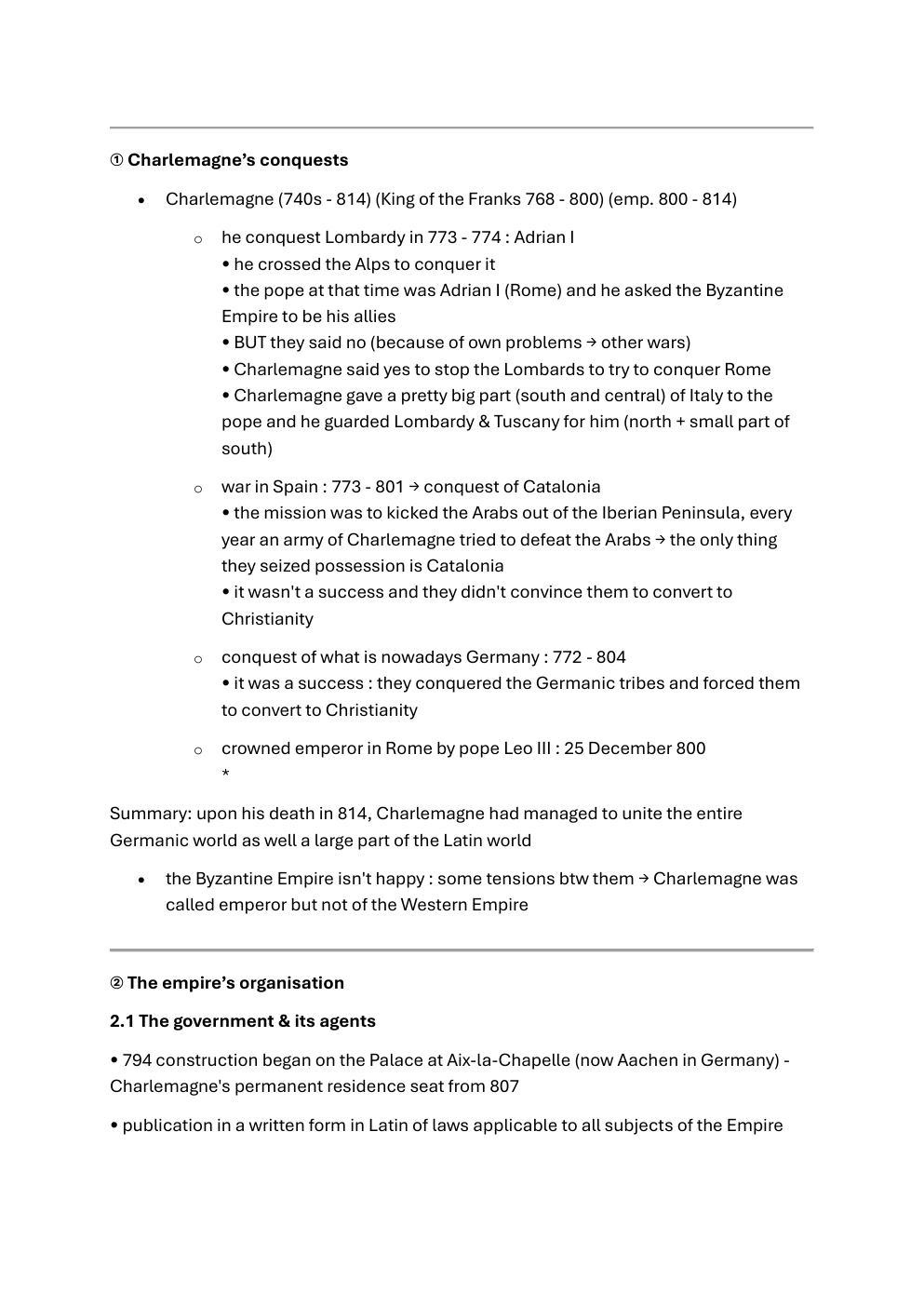
① Charlemagne’s conquests
•
Charlemagne (740s - 814) (King of the Franks 768 - 800) (emp.
800 - 814)
o
he conquest Lombardy in 773 - 774 : Adrian I
• he crossed the Alps to conquer it
• the pope at that time was Adrian I (Rome) and he asked the Byzantine
Empire to be his allies
• BUT they said no (because of own problems → other wars)
• Charlemagne said yes to stop the Lombards to try to conquer Rome
• Charlemagne gave a pretty big part (south and central) of Italy to the
pope and he guarded Lombardy & Tuscany for him (north + small part of
south)
o
war in Spain : 773 - 801 → conquest of Catalonia
• the mission was to kicked the Arabs out of the Iberian Peninsula, every
year an army of Charlemagne tried to defeat the Arabs → the only thing
they seized possession is Catalonia
• it wasn't a success and they didn't convince them to convert to
Christianity
o
conquest of what is nowadays Germany : 772 - 804
• it was a success : they conquered the Germanic tribes and forced them
to convert to Christianity
o
crowned emperor in Rome by pope Leo III : 25 December 800
*
Summary: upon his death in 814, Charlemagne had managed to unite the entire
Germanic world as well a large part of the Latin world
•
the Byzantine Empire isn't happy : some tensions btw them → Charlemagne was
called emperor but not of the Western Empire
② The empire’s organisation
2.1 The government & its agents
• 794 construction began on the Palace at Aix-la-Chapelle (now Aachen in Germany) Charlemagne's permanent residence seat from 807
• publication in a written form in Latin of laws applicable to all subjects of the Empire
• division of the empire into more than 300 "countries" = approx.
3500 officials (counts + assistants) • borderland regions = "marches", placed under the authority of military leaders (mostly "margraves/marquesses" or sometimes dukes) • Counts, margraves/marquesses & dukes carried out the emperor's laws, gathered his armies and collected his taxes • chosen from Charlemagne's aristocratic supporters, they were compensated for their work by temporary grants of lands rather than with salaries • royal envoys (missi dominici = "those sent out by the lord king") regularly visited and controlled the administration of counties and marches • introduction of vassalage to unify and solidify the Empire (relationship btw vassal/lord) 2.2 Ruler’s power • the army: all free men must perform military service importance of the heavy cavalry • the sovereign's land wealth (= royal estates) • other revenues: taxes and tolls (pedage) • the justice system: 7 professional judges per country/march/court These courts of justice were presided by the local count/margrave/marquess/duke who did not participate in the final verdict 2.3 The Church • the emperor governed the Frankish Church without, however, being its head o he imposed his laws on it o he gathered and presided over the ecclesiastical councils/synods ▪ o formal assembly of the Church leaders & theologians he chose bishops, abbots & abbesses (some were laymen/laywomen), who needed also to maintain & command their own military contingents 2.4 The economy • cities regained their importance by becoming the residence of counts/margraves/margraveses/dukes & bishops • need for a currency based on a single denomination ⇒ creation of the silver denarius (1.7g coin) used: o to pay official & imperial troops o to pay the emperor's expenses o and to allow the population to pay for their transactions and.... »
↓↓↓ APERÇU DU DOCUMENT ↓↓↓

Liens utiles
- Jane Austen I INTRODUCTION Jane Austen English author Jane Austen crafted satirical romances set within the confines of upper-middle-class English society.
- High Middle Age (1050-1300) - history
- Course of reading and writing for 1st year English Licence
- EXPOSE SUR L'AGE DE LA TERRE
- LA MUSIQUE AU MOYEN AGE