



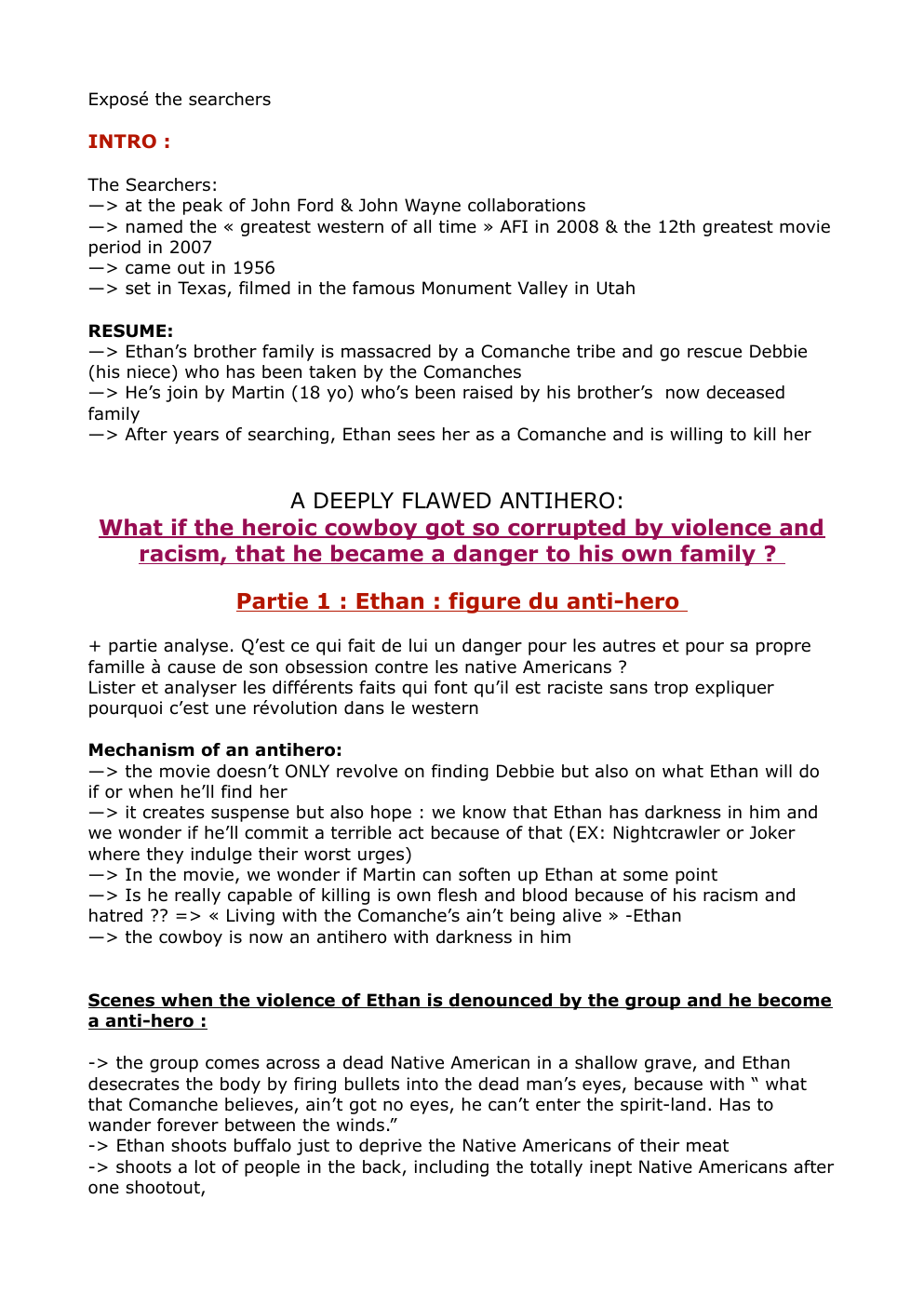
exposé The Searchers John Ford
Publié le 11/04/2026
Extrait du document
«
Exposé the searchers
INTRO :
The Searchers:
—> at the peak of John Ford & John Wayne collaborations
—> named the « greatest western of all time » AFI in 2008 & the 12th greatest movie
period in 2007
—> came out in 1956
—> set in Texas, filmed in the famous Monument Valley in Utah
RESUME:
—> Ethan’s brother family is massacred by a Comanche tribe and go rescue Debbie
(his niece) who has been taken by the Comanches
—> He’s join by Martin (18 yo) who’s been raised by his brother’s now deceased
family
—> After years of searching, Ethan sees her as a Comanche and is willing to kill her
A DEEPLY FLAWED ANTIHERO:
What if the heroic cowboy got so corrupted by violence and
racism, that he became a danger to his own family ?
Partie 1 : Ethan : figure du anti-hero
+ partie analyse.
Q’est ce qui fait de lui un danger pour les autres et pour sa propre
famille à cause de son obsession contre les native Americans ?
Lister et analyser les différents faits qui font qu’il est raciste sans trop expliquer
pourquoi c’est une révolution dans le western
Mechanism of an antihero:
—> the movie doesn’t ONLY revolve on finding Debbie but also on what Ethan will do
if or when he’ll find her
—> it creates suspense but also hope : we know that Ethan has darkness in him and
we wonder if he’ll commit a terrible act because of that (EX: Nightcrawler or Joker
where they indulge their worst urges)
—> In the movie, we wonder if Martin can soften up Ethan at some point
—> Is he really capable of killing is own flesh and blood because of his racism and
hatred ?? => « Living with the Comanche’s ain’t being alive » -Ethan
—> the cowboy is now an antihero with darkness in him
Scenes when the violence of Ethan is denounced by the group and he become
a anti-hero :
-> the group comes across a dead Native American in a shallow grave, and Ethan
desecrates the body by firing bullets into the dead man’s eyes, because with “ what
that Comanche believes, ain’t got no eyes, he can’t enter the spirit-land.
Has to
wander forever between the winds.”
-> Ethan shoots buffalo just to deprive the Native Americans of their meat
-> shoots a lot of people in the back, including the totally inept Native Americans after
one shootout,
-> shoot a barkeep who gave him a tip on where to find Chief Scar (in order to get his
money back).
-> he wants to kill Debby.
-> this violence is not well seen by the group and so is not completely normalized by
the film and the director, even if in another moment, Martin, who is seen as a positive
young man, punch and hurt a Native American woman who likes him and it is
supposed to be felt as something funny.
Partie 2 : Un film au racisme décomplexé
Complicating the fantasy:
—> Ethan’s character bring a sort of security & satisfaction: a sort of commanding
father figure, extremely violent but choose violence for good (to kill the « bad guys »,
here the Comanches)
—> he isn’t a part of a government or any important role in the country (or not
anymore) but he’s a capable man, roaming the world to make it safer and better for
his loved ones
—> Of course its a problematic point of view: it involves extreme violence and racism
(particularly in this movie)
—> BUT, it’s still a part of a certain « fantasy » there someone is protecting us and
making us feel safe = AN HERO
Racist things :
-> White homesteaders would build their ranches in the sacred place of the Native
Americans without caring
-> Native Americans = depicted as caricatures (caricatural and cheep paint and
costumes)
-> depicted as cruel animals : kill the white men’s cattle with their spears, leave the
carcasses to rot on the open terrain, and try to kill and scalp as many white men and
women as they can.
-> Also depicted as completely inept in every shootout
Chief Scar : German born Henry Brandon (whose other roles included Persian, Arab,
and Asian villains)
Native american Woman: overweight and has a silly smile, so this served as great
comic relief in the film.
No respect for her while she in on their side : They call her
“Look”, because they can’t be bothered to try and learn how to pronounce her actual
name.
They punch her.
-> Ethan refers to his adopted nephew Martin as a “half-breed” because he is 1/8th
Cherokee, and later also calls him a “blanket-head”.
John Wayne, who was even quoted this way in an interview:
“I don’t feel we did wrong in taking this great country away from them (the Native
Americans) … Our so-called stealing of this country from them was just a matter of
survival.
There were great numbers of people who needed new land, and the Indians
were selfishly trying to keep it for themselves.”
Partie 3 : Revolution dans le Western
On a affaire à un perso principal + complexe, sorte de rédemption, remise en question
(shot de fin)
critique, pk cette figure du anti-hero expliquée dans la 1e partie est une révolution
dans le western.
—> this fantasy is complicated because they make the supposed « hero » a dark
father figure who’s obsessed with violence and racism
—> as a former confederate soldier, where does he put his violence now ?
—> the last shot of a movie shows that those kind of men (the kind rooted in violence
like Ethan) don’t or can’t be part of society, can’t have a « normal » family and a
home
—> served the complexity of a character like Ethan
Troublesome antagonist:
Martin is great example
—> Despite Ethan racism towards him, they manage to travel and work together and
also develop a camaraderie
—> Martin’s identity (an heroic figure who is part Native American) he challenges
Ethan’s core antihero tendencies like his racism
—> Martin is also antagonistic in other ways: he obstructs Ethan from achieving his
ultimate goal => killing Debbie
—> he challenges Ethan’s beliefs through their interactions and may almost be the
reason Ethan had decided to save Debbie instead of killing her
—> This pattern - a supporting character of color functioning as a Troublesome
Antagonist, helping a protagonist grow out of their racism - is an Oscar magnet (IN
THE HEAT OF THE NIGHT, DRIVING MISS DAISY, GREEN BOOK)
463 -> 1852
580, 582, 311, 362
522, 428, 418, 429
Introduction
255
Today, we are going to talk about The Searchers, a major western directed by John
Ford and John Wayne.
This movie is often considered like the peak of the long
collaboration between Ford and Wayne, who together helped to define the classical
western.
Released in 1956, the film is set in Texas but was mainly shot in Monument Valley.
These spectacular landscapes became one of John Ford’s visual trademarks and
contributed to the mythic image of the American West.
Over time, The Searchers has received major critical recognition.
The American Film
Institute named it as the greatest western of all time in 2008, and today it is widely
studied in film history.
At first, the story seems simple.
Ethan Edwards, a former Confederate soldier, returns
at his home after the Civil War.
Soon after, his brother’s family is massacred by a
Comanche tribe, and his young niece Debbie is kidnapped.
Ethan then spends years
searching for her, accompanied by Martin, his adopted nephew.
However, the movie is much more complex than a simple rescue story.
It leads us to
the central question of our presentation:
What if the heroic cowboy got so corrupted by violence and racism that he became a
danger to his own family?
To answer at this question, we will first analyze how Ethan Edwards is constructed as
a deeply flawed antihero.
Then, we will examine how the film both reproduces and
complicates racist representations.
Finally, we will explain why The Searchers
represents a turning point in the history of the western.
Part 1.
Ethan Edwards an antihero figure
580
293
First, Ethan Edwards clearly challenges the traditional image of the western hero.
In classical westerns, the cowboy is usually presented as morally right, brave, and
protective.
He uses violence only in the name of justice.
However, Ethan is very
different.
From the beginning of the movie, we can sense something disturbing about
him.
He is secretive, emotionally distant, and visibly marked by the Civil War.
Unlike the
typical western hero, he does not seem fully integrated into family life or peaceful
society.
Very quickly,....
»
↓↓↓ APERÇU DU DOCUMENT ↓↓↓

Liens utiles
- exposé anglais introduction to the Consumer Society
- ÉCOLE ET SOCIÉTÉ ou ÉDUCATION ET SOCIÉTÉ, The School and Society, 1899. John Dewey
- AMERS de SAINT-JoHN PERSE. Poème (exposé de l’oeuvre)
- PITIÉ ÉTERNELLE (La) [The Everlasting Mercy] de JOHN MASEFIELD
- SAGA DES FORSYTE (La) [The Forsyte Saga] John Galsworthy