
exposé en anglais
Publié le 17/04/2026
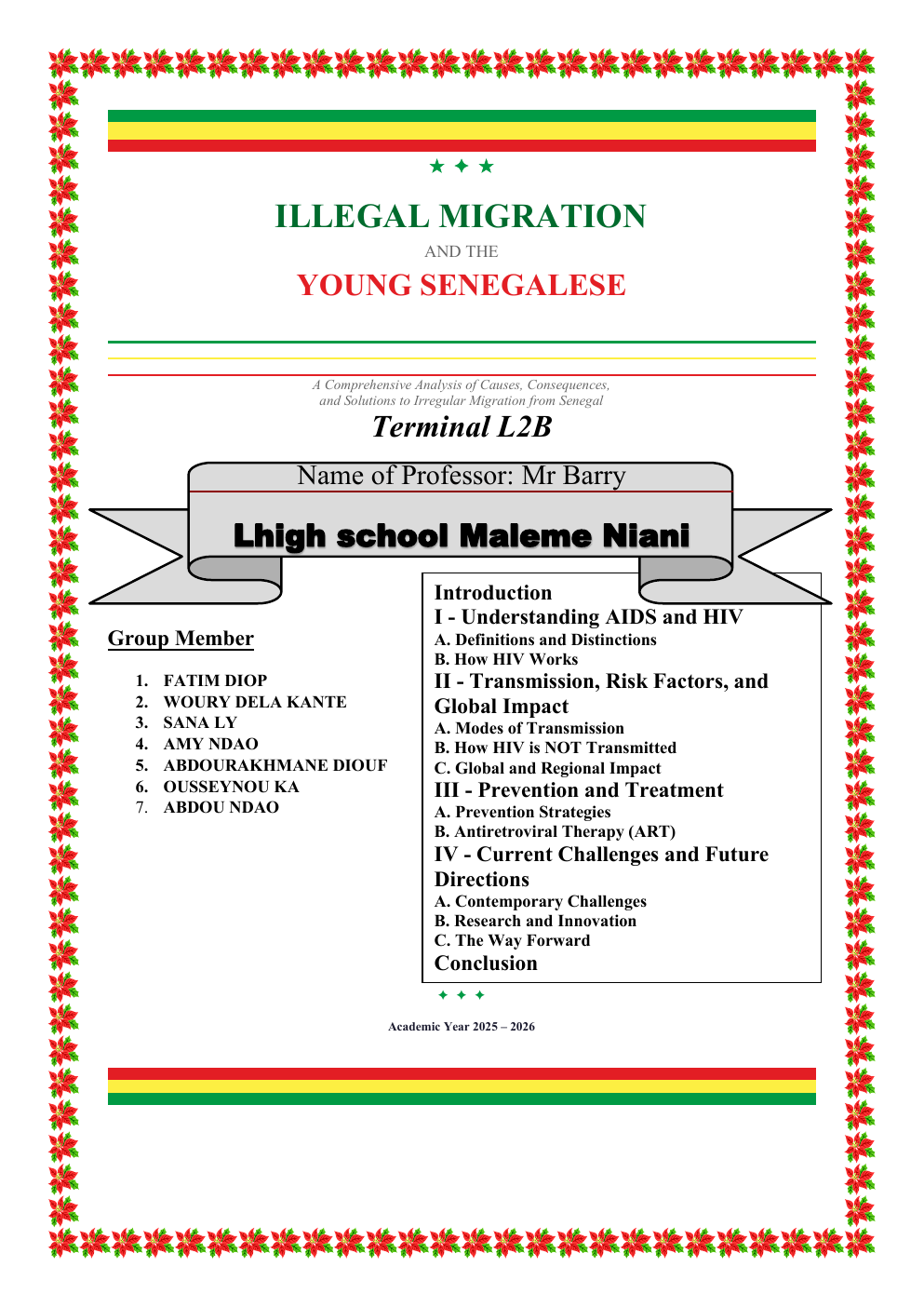
Extrait du document
«
★ ✦ ★
ILLEGAL MIGRATION
AND THE
YOUNG SENEGALESE
A Comprehensive Analysis of Causes, Consequences,
and Solutions to Irregular Migration from Senegal
Terminal L2B
Name of Professor: Mr Barry
Introduction
I - Understanding AIDS and HIV
Group Member
1.
2.
3.
4.
5.
6.
7.
FATIM DIOP
WOURY DELA KANTE
SANA LY
AMY NDAO
ABDOURAKHMANE DIOUF
OUSSEYNOU KA
ABDOU NDAO
A.
Definitions and Distinctions
B.
How HIV Works
II - Transmission, Risk Factors, and
Global Impact
A.
Modes of Transmission
B.
How HIV is NOT Transmitted
C.
Global and Regional Impact
III - Prevention and Treatment
A.
Prevention Strategies
B.
Antiretroviral Therapy (ART)
IV - Current Challenges and Future
Directions
A.
Contemporary Challenges
B.
Research and Innovation
C.
The Way Forward
Conclusion
✦ ✦ ✦
Academic Year 2025 – 2026
Introduction
In recent decades, illegal migration has become one of the most pressing humanitarian
and geopolitical challenges of the 21st century.
Senegal, a small yet vibrant West African
nation, has emerged as one of the primary countries of origin for irregular migrants attempting
to reach Europe, particularly through the treacherous Atlantic routes toward the Canary Islands
or across the Sahara Desert toward North Africa.
The phenomenon is not simply a matter of economic desperation; it is deeply rooted in
structural inequalities, social aspirations, political instability, and a generational crisis of
opportunity.
Young Senegalese men and women — often between the ages of 18 and 35 —
represent the vast majority of those who undertake these dangerous journeys, frequently at
the cost of their lives.
The Mediterranean and Atlantic Oceans have become mass graves for
thousands of African youth seeking a better future.
This exposé seeks to examine the multifaceted nature of illegal migration among young
Senegalese people.
It explores the underlying causes that push them to leave their homeland,
the devastating human and social consequences of this phenomenon, and the various
responses — both domestic and international — that have been proposed or implemented to
address it.
Through this analysis, we aim to shed light on a complex issue that demands urgent,
compassionate, and sustainable solutions.
I.
The Causes of Illegal Migration
1.
Economic Factors
The most frequently cited driver of illegal migration among young Senegalese is
economic hardship.
Despite Senegal's relatively stable political environment and modest
economic growth, the country continues to struggle with high rates of youth unemployment,
underemployment, and poverty.
According to various estimates, youth unemployment in
Senegal hovers around 40%, with rural areas experiencing even higher rates of economic
exclusion.
Senegal's economy, while diversified across agriculture, fishing, tourism, and services,
has not been able to generate sufficient formal employment opportunities to absorb its rapidly
growing youth population.
The agricultural sector, which employs a significant portion of the
rural population, remains vulnerable to climate change, desertification, and declining fish
stocks — all of which threaten traditional livelihoods.
Many young people from coastal
communities such as Mbour, Saint-Louis, and Ziguinchor, who once relied on artisanal fishing,
now find their economic base severely eroded.
Relative deprivation: Beyond absolute poverty, the perception of inequality plays a
major role.
The proliferation of social media and mobile technology has made young
Senegalese acutely aware of living standards in Europe and North America, fueling a powerful
sense of relative deprivation.
The desire to achieve material prosperity comparable to that seen
online becomes a powerful motivator for migration, even when it means risking one's life.
2.
Political and Social Instability
While Senegal is often praised as one of West Africa's most stable democracies, it is
not immune to political tensions.
In recent years, political crises, including mass protests, the
arrest of opposition leaders, and controversies surrounding electoral processes, have
deepened disillusionment among young people.
Many young Senegalese feel politically
1
marginalized and believe that the system offers them no genuine avenue for social
advancement or political participation.
Social factors also play a crucial role.
The concept of 'Barça ou Barsax' — a Wolof
expression meaning 'Barcelona or death' — captures the fatalistic attitude held by some young
Senegalese toward migration.
Social pressure from family and community, combined with the
glorified status of those who succeed abroad, creates a cultural environment in which leaving
the country is seen as the ultimate marker of ambition and success.
Returnees who come back
with money, cars, and prestige reinforce this narrative, often concealing the hardships they
endured to achieve it.
Gender dynamics also shape migration patterns.
Young Senegalese women
increasingly migrate — often undocumented — to escape gender-based violence, early
marriage, or limited access to education and economic opportunities.
For them, migration is
frequently both an economic and a personal liberation strategy.
3.
Smuggling Networks
The existence of well-organized, transnational smuggling networks significantly
facilitates illegal migration from Senegal.
These networks operate across West Africa and the
Sahel, offering migrants a complete package of services: transportation, forged documents,
lodging along the route, and guarantees of passage across international borders.
Their
business model is highly adaptable, shifting routes in response to law enforcement pressure.
Smugglers typically charge between $500 and $3,000 per person for the journey to
Europe, depending on the route taken.
Families often pool resources or take out loans to
finance a young relative's journey, viewing it as a collective investment in the family's future.
This financial interdependence creates enormous pressure on migrants to succeed, as failure
means not only personal tragedy but also the financial ruin of the entire family.
Digital technology has transformed smuggling networks.
Social media platforms and
encrypted messaging applications are now used to recruit migrants, advertise services, and
coordinate logistics.
This has made these networks more efficient and more difficult to
dismantle through traditional law enforcement methods.
II.
The Consequences of Illegal Migration
1.
Human Consequences
The human cost of illegal migration from Senegal is catastrophic.
The Atlantic route
from the Senegalese coast to the Canary Islands spans approximately 1,500 kilometers of
open ocean, and is considered one of the deadliest migration routes in the world.
Overloaded
wooden pirogues, designed for coastal fishing, are utterly unsuitable for such a journey.
Capsizings, engine failures, starvation, and dehydration claim thousands of lives every year.
According to the International Organization for Migration (IOM), thousands of
Senegalese migrants have lost their lives attempting this crossing.
Many more disappear
without a trace — swallowed by the ocean, their deaths never officially recorded.
The
psychological toll on surviving families left behind is immense: grief, uncertainty, and social
stigma compound their suffering.
For survivors: Those who reach their destination do not necessarily find the prosperity
they dreamed of.
Many live clandestinely, without legal status, subject to exploitation,
discrimination, and precarious living conditions.
They often cannot access healthcare,
2
education, or legal protection.
Undocumented migrants are vulnerable to forced labor, sexual
exploitation, and human trafficking.
The phenomenon also creates a serious public health dimension.
Migrants subjected
to violence, trauma, and extreme physical deprivation often arrive with severe physical and
psychological injuries.
Post-traumatic stress disorder (PTSD), depression, and anxiety....
»
↓↓↓ APERÇU DU DOCUMENT ↓↓↓

Liens utiles
- exposé anglais introduction to the Consumer Society
- Exposé Marseille en anglais
- Exposé fort Boyard en anglais
- Exposé anglais
- exposé sur les roms en anglais