
828 résultats pour "century"
-
John Milton
I
INTRODUCTION
John Milton
Seventeenth-century writer John Milton ranks as one of the greatest poets in the history of English literature.
liberty to know, to utter, and to argue freely according to conscience, above all liberties.” In Of Education (1644) Milton advocated an education combining classical instruction, to prepare the student for government service, with religious training. The third group of pamphlets includes those Milton wrote to justify the execution of Charles I. The first of these, The Tenure of Kings and Magistrates (1649), deals with constitutional questions and particularly with the rights of the people a...
-
Adolf Hitler
I
INTRODUCTION
Adolf Hitler (1889-1945), German political and military leader and one of the 20th century's most powerful dictators.
A Economic Collapse At the end of World War I, the Allies (those countries who had fought against Germany) had demanded that Germany pay reparations—that is, payments for wardamages. The government refused to pay all that was demanded by the Allies. When Germany failed to pay enough, France and Belgium occupied the coal mines in theRuhr industrial area in west central Germany in January 1923. In protest, the German government halted all reparation payments and called for passive resistance by a...
- Denzel Washington Denzel Washington, born in 1954, American motion-picture, theater, and television actor, one of the major African American actors of the late 20th century.
- Tecumseh: "Once a Happy Race" Early in the 19th century, Governor William Henry Harrison of the Indiana Territory made a number of treaties with Native Americans that involved the ceding of land to the United States government.
- Walter Gropius Walter Gropius (1883-1969), German American architect and educator, who founded the Bauhaus, a German art school that became a seminal force in architecture and applied art during the first half of the 20th century.
- Duke Ellington Duke Ellington (1899-1974), American jazz composer, orchestrator, bandleader, and pianist, considered the greatest composer in the history of jazz music and one of the greatest musicians of the 20th century.
- The Teachings of Muhammad During the early 7th century, a trader named Muhammad was meditating in a cave near Mecca in what is now Saudi Arabia, when he experienced a vision of the archangel Gabriel who declared Muhammad to be a prophet of God.
- Henri Matisse Henri Matisse (1869-1954), French artist, leader of the fauve group (see Fauvism), regarded as one of the great formative figures in 20th-century art, a master of the use of color and form to convey emotional expression.
-
-
Architecture, aesthetics of
accounts of the geometrical discoveries of Plato and Pythagoras. He cites the latter's famous triangle theorem andadds, 'When Pythagoras discovered this fact, he had no doubt that the Muses had guided him… and it is said thathe very gratefully offered sacrifice' ( 1914: 253 ). AlthoughVitruvius is concerned with the practical applications of the theorem, mention of Pythagoras and the occult nature of his discovery expressed the common view thatperceptible forms are underwritten by an a...
-
indigetes (dii indigites) Roman Apparently,
lesser gods of the many people who inhabited Central
Italy in the seventh and early sixth centuries b.
used the term dii indigites to distinguish the many personal gods from the dii novensiles , or newcomer gods, particularly those brought to the Italian peninsula by Greek colonists. Some argue more specifically that the indigetes were the group of gods named in one of the oldest recovered calendars of Roman festivals, inscribed in a stucco wall sometime in the sixth century b.c. and discovered by archaeologists in the early 20th century.
-
Averroism
approach to philosophical problems, even though this must lead to conflict with Christian faith; and third, the current led by Albert the Great and Aquinas, who produced a synthesis of Aristotle and Christian faith (see Aristotelianism, medieval ). Early in the twentieth century, it was commonly assumed by historians that almost all the 219 theses condemned in 1277 were of Averroist provenance, and since there is medieval evidence that the main targets of the condemnation were Boethius of Daci...
-
Karl Marx
I
INTRODUCTION
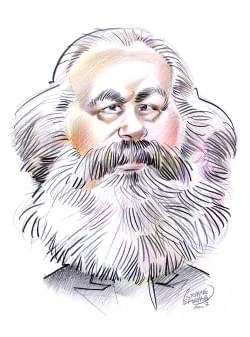
Karl Marx (1818-1883), German political philosopher and revolutionary, the most important of all socialist thinkers and the creator of a system of thought called
Marxism.
his death, were revived in the 20th century by Vladimir Ilich Lenin, who developed and applied them. They became the core of the theory and practice of Bolshevismand the Third International. Marx’s ideas, as interpreted by Lenin, continued to have influence throughout most of the 20th century. In much of the world, includingAfrica and South America, emerging nations were formed by leaders who claimed to represent the proletariat. Microsoft ® Encarta ® 2009. © 1993-2008 Microsoft Corporation. A...
-
Karl Marx.
his death, were revived in the 20th century by Vladimir Ilich Lenin, who developed and applied them. They became the core of the theory and practice of Bolshevismand the Third International. Marx’s ideas, as interpreted by Lenin, continued to have influence throughout most of the 20th century. In much of the world, includingAfrica and South America, emerging nations were formed by leaders who claimed to represent the proletariat. Microsoft ® Encarta ® 2009. © 1993-2008 Microsoft Corporation. A...
-
Aksum.
doctrine that Christ was both divine and human. The Council of Chalcedon condemned Monophysitism in 451, and since that time the Coptic Church has beenindependent of other Christian churches. After the Council of Chalcedon, priests who continued to teach Monophysitism were persecuted in the eastern Roman Empire, and many migrated to Aksum. The influxof priests, along with the support of the royal family, strengthened missionary efforts in Aksum. Many churches and monasteries were founded after 4...
-
Aksum.
doctrine that Christ was both divine and human. The Council of Chalcedon condemned Monophysitism in 451, and since that time the Coptic Church has beenindependent of other Christian churches. After the Council of Chalcedon, priests who continued to teach Monophysitism were persecuted in the eastern Roman Empire, and many migrated to Aksum. The influxof priests, along with the support of the royal family, strengthened missionary efforts in Aksum. Many churches and monasteries were founded after 4...
-
Civil Law.
Beginning in the 15th century, many European countries extensively colonized North and South America, Africa, and parts of Asia ( see Colonialism and Colonies). Colonial expansion spread the civil law system as colonizers imposed their system of law on their colonies. After achieving independence, some former colonies retainedthe legal system established by the colonizer. For example, the African nation of Senegal has retained the civil law system established by France. Other former colonieschos...
-
-
Japanese Art and Architecture
I
INTRODUCTION
Otani Oniji as Eitoku
Otani Oniji as Eitoku is one of a number of woodblock prints created by the artist T? sh ?sai Sharaku between 1794 and
1795 during the Edo period in Japan.
Jō mon PotteryJapan’s J ōmon people, who thrived from 10,000 to 300 bc, made distinctive pottery for boiling, steaming, and storing food.The pots were made with coils of clay and then decorated by rolling carved sticks, plant fibers, or braided cords over theouter surface. This cord-marked (j ōmon) pottery gave the culture its name.Scala/Art Resource, NY The first settlers of Japan, the J ōmon people (10,000?-300? BC), named for the cord markings that decorated the surfaces of their clay vessel...
-
Fredericton - Geography.
As a provincial center for government, forestry, military activities, and agriculture, Fredericton grew from 4400 residents in 1848 to 7117 by 1901. Telegraph lines wereestablished in 1851, telephones in 1888, and radio broadcasts in 1923. Early newspapers included the New Brunswick Reporter (1844-1902) and the Maritime Farmer (1879-1905). After 1850 Fredericton flourished as an industrial town. Sawmills, shipyards, tanneries, boot and shoe factories, carriage shops, iron foundries, brickyard...
-
Magna Carta
I
INTRODUCTION
Magna Carta (Latin, "Great Charter"), document sealed by King John of England on June 15, 1215, in which he made a series of promises to his subjects that he would
govern England and deal with his vassals according to the customs of feudal law (see Feudalism).
The importance of the Magna Carta lies more in its symbolism than in its words. As a result, many modern rights have been based on the Magna Carta that wereunknown in the 13th century, including habeas corpus and the principle of no taxation without representation. Neither of these concepts existed in the original Magna Carta of 1215 but both became accepted as English law during the early 17th century. At that time, members of Parliament, the English legislative assembly, who opposed the rule...
-
Magna Carta .
The importance of the Magna Carta lies more in its symbolism than in its words. As a result, many modern rights have been based on the Magna Carta that wereunknown in the 13th century, including habeas corpus and the principle of no taxation without representation. Neither of these concepts existed in the original Magna Carta of 1215 but both became accepted as English law during the early 17th century. At that time, members of Parliament, the English legislative assembly, who opposed the rule...
-
Prints and Printmaking
I
INTRODUCTION
Prints and Printmaking, pictorial images that can be inked onto paper, and the art of creating and reproducing them.
Bewick’s The SkylarkBritish engraver Thomas Bewick’s The Skylark is part of his History of British Birds (2 vols., 1797 and 1804). Bewick wasthe first artist to demonstrate the full potential of wood engraving and is renowned for his fine natural history illustrations.Each illustration shows some of the bird’s natural habitat.Folio Society, London/Bridgeman Art Library, London/New York Historically, the wood engraving was chiefly used for illustrations in magazines and books. It is similar to th...
-
Latin American Painting
I
INTRODUCTION
Diego Rivera Museum Gallery
The studio of Mexican painter Diego Rivera is now maintained as an art museum in Mexico City.
The Viceroy Arrives at PotosíThe discovery of silver on a hillside near the town of Potosí in 1545 turned this Bolivian city into a key Spanish possessionin the Americas. The population of Potosí shot up until it reached 150,000 inhabitants by the year 1611. The work shownhere, The Viceroy Arrives at Potosí, by 17th-century Bolivian painter Melchor Pérez de Holguín, was painted during thezenith of the town’s fortunes.Archivo Fotografico Oronoz From about 1580 to 1650 European styles became domin...
-
Latin America.
adequate housing and services, most were forced to live in shantytowns that came to encircle all large Latin American cities. One of the key problems facing Latin America in the late 20th century was the rapid rise of external debt during the 1980s. The borrowed money had been used bycorrupt, or at best inefficient, governments in non-productive projects. These large debts meant that many countries had to spend up to 30 percent of their net incometo pay interest on their loans. Some countries, s...
-
what is progress
In the XIXth century the "progress" became an economic notion, then became scientific. It is late r still that it has been joined by the notion of innovation. Progress = potentiality XXth century, by analyzing the impact of the technical progress on the working population, the demographer and the economist Alfred Sauvy introduces the distinction between " processif progress " and " recessive progress ". Progressive = benefit to the dominants; processif beneficit to the dominated....
-
-
Medicine.
C Other Health Professionals Medicine is not restricted to physicians. A wide variety of health care practitioners work in this exciting field. By far the largest professional group is nurses. Registerednurses help physicians during examinations, treatment, and surgery. They observe, evaluate, and record patients’ symptoms, administer medications, and provideother care ( see Nursing). Nurse practitioners perform basic duties once reserved for physicians, such as diagnosing and treating common i...
-
Philadelphia (city, Pennsylvania) - geography.
national trend of migration from eastern cities to the warmer climate of the Sun Belt. Whereas in 1950 Philadelphia contained more than 2 million people and ranked as the third largest city in America, the city's population plunged to 1,517,550 by 2000.In 2006, the city's population was estimated at 1,448,394. While the city proper was decreasing in population, the metropolitan area centered on Philadelphia grew. In 2006 the region had 6.2 million inhabitants. Philadelphiaranked as the nation’s...
-
Hungary - country.
Northern Hungary lacks sufficient water, especially between July and October, when precipitation levels are typically low. Canals irrigate the Great Hungarian Plain,which is subject to drought. Because of the country’s mainly flat terrain, only limited water resources can be harnessed for hydroelectric power. F Environmental Issues Rapid industrialization in Hungary following World War II contributed significantly to a number of major environmental problems, including air, water, and soil pollu...
-
Renaissance Art and Architecture
I
INTRODUCTION
Renaissance Composition
During the Renaissance (15th and 16th centuries) artists discovered new ways to help them create more realistic and
compelling images.
with reliefs, had been familiar for centuries. A Early Renaissance Sculpture Ghiberti’s Gates of ParadiseThe Gates of Paradise are bronze doors created by Italian Renaissance sculptor Lorenzo Ghiberti between 1425 and 1452for the east entrance to the baptistery of the Florence Cathedral in Italy. This detail, showing Isaac and Esau, is from oneof the doors' ten panels, each of which illustrates a story from the Bible. Ghiberti endowed the scenes with volume, depth,and movement, and helped initi...
-
Technology.
loose soil in this region, known as the Fertile Crescent, was easily scratched for planting, and an abundance of trees was available for firewood. By 5000 BC, farming communities were established in areas known today as Syria, Turkey, Lebanon, Israel, Jordan, Greece, and the islands of Crete and Cyprus. Agricultural societies in these places constructed stone buildings, used the sickle to harvest grain, developed a primitive plowstick, and advanced their skills inmetalworking. Trade in flint al...
-
Qing Dynasty - History.
The Manchus also dealt with the problem of Russian expansion into northeastern Asia. In 1689 the Treaty of Nerchinsk was signed by an envoy from the Manchu courtand a Russian representing Peter the Great. The treaty, the first between China and a Western country, established territorial boundaries and defined rules ofcommerce for the two powers. Through the mid-18th century, the Manchus continued to consolidate their power. In 1720 the Qing ruler sent forces to fight the Mongols in Tibet and the...
-
William Blake
I
INTRODUCTION
William Blake (1757-1827), English poet, painter, and engraver, who created an unusual form of illustrated verse; his poetry, inspired by mystical vision, is among the
most original, lyric, and prophetic in the language.
Your spring & your day are wasted in play,And your winter and night in disguise. Both series of poems take on deeper resonances when read in conjunction. Innocence and Experience, “the two contrary states of the human soul,” are contrasted insuch companion pieces as “The Lamb” and “The Tyger.” Blake’s subsequent poetry develops the implication that true innocence is impossible without experience,transformed by the creative force of the human imagination. III BLAKE AS ARTIST The LambThe Lamb...
-
Libya - country.
junipers and mastic trees are found in the higher elevations. Only a few large mammals are found in Libya. Wildlife includes desert rodents, hyenas, gazelles, and wildcats. Eagles, hawks, and vultures are common. E Environmental Issues Libya has undertaken a number of major irrigation projects intended to ease the country’s water shortage. The most ambitious is the so-called Great Man-Made River(GMMR), a massive 25-year irrigation scheme begun in 1984. The GMMR is a vast water pipeline system d...
-
-
Asia - Geography.
Borneo, the world’s third largest island after Greenland and New Guinea. To the southeast is the Timor Sea separating the Asian island of Timor from the Australiancontinent. The Indian subcontinent is flanked by the Bay of Bengal on the east and the Arabian Sea on the west. The island of Sri Lanka and the much smaller Maldives andNicobar Islands trail away to the south. The Arabian Sea’s Gulf of Aden, the Red Sea, the Mediterranean Sea, and the Black Sea form an arc along the western rim of Asia...
-
Asia - History.
Borneo, the world’s third largest island after Greenland and New Guinea. To the southeast is the Timor Sea separating the Asian island of Timor from the Australiancontinent. The Indian subcontinent is flanked by the Bay of Bengal on the east and the Arabian Sea on the west. The island of Sri Lanka and the much smaller Maldives andNicobar Islands trail away to the south. The Arabian Sea’s Gulf of Aden, the Red Sea, the Mediterranean Sea, and the Black Sea form an arc along the western rim of Asia...
-
Ghana - country.
times of depressed cacao prices, Ghana has significantly increased exports of timber to generate needed revenue. In 1988 Ghana initiated a conservation plan called the Forest Resource Management Project. In 1989 Ghana restricted the export of 18 tree species, and in 1994 thecountry banned the export of raw logs. About 4.8 percent (1997) of the country’s land is officially protected, but illegal logging threatens Ghana’s remaining forests. Deforestation, overgrazing, and periodic drought have led...
-
Sweden - country.
mi) and is Sweden’s second largest lake, after Vänern. The two lakes, together with several smaller lakes, rivers, and canals, form an internal water route called theGöta Canal. Built in the early 19th century, the Göta Canal extends for about 386 km (about 240 mi) and provides a scenic transportation link between the Baltic Sea,at Stockholm, and the Kattegat. Sweden’s other large lakes in the district include Mälaren, Hjälmaren, and the famously picturesque Siljan. D Climate Although one-seven...
-
Bulgaria - country.
E Climate Most of Bulgaria has a continental climate, with cold winters and hot summers. The climate in general is more severe than in other European areas of the samelatitudes, and the average annual temperature range is greater than that of neighboring countries. Severe droughts, frosts, winds, and hail storms frequently damagecrops. A Mediterranean climate, with dry summers and mild, humid winters, prevails in the valley of the southwestern Rhodope Mountains; the northern limit of theclimati...
-
Popular Music
I
INTRODUCTION
Satchmo Sings "Back O' Town Blues"
One of the founders of instrumental jazz music, American Louis Armstrong, known as Satchmo, also profoundly influenced
vocal jazz and popular song.
disseminating popular music until the 1920s remained printed sheet music. By the late 19th century, the music-publishing business was centralized in New York City,particularly in an area of lower Manhattan called Tin Pan Alley. “After the Ball” (1892) by Charles K. Harris, the first popular song to sell 1 million copies—in this case, ofsheet music—inspired rapid growth in the music-publishing industry. Composers were hired to rapidly produce popular songs by the dozens, and the techniques ofFost...
-
Pan-Africanism.
(in New York City). These congresses were attended by increasing numbers of representatives from the United States, Europe, Africa, and the Caribbean. Severalimportant factors affected the growing popularity of the congresses. First, many delegates were sponsored by international labor movements, which were growing insize and power in the 1920s. A second factor was the growth of the black nationalist movement of Marcus Garvey. The Garvey movement was important in the UnitedStates as a popular ex...
-
South America - Geography.
South America is dominated by relatively warm climatic regimes. Spanning nearly the entire continent along the equator is a belt of humid tropical climate that grades tothe north and south into broad zones where the length of the rainy season and the amount of rainfall diminish. These zones have wet summers and dry winters and aresubject to prolonged droughts. Droughts are a particularly serious problem in northeastern Brazil and along the northern coast of Venezuela and Colombia. The areas ofra...
-
-
New Hampshire - geography.
Washington. D1 Temperature The coldest parts of the state are in the White Mountains and the extreme north. Average January temperatures range from about -11° C (about 12° F) along theCanadian border to about -3° C (about 26° F) along the coast. July temperatures range from about 17° C (about 63° F) in the mountains to about 21° C (about 70° F)in the south. D2 Precipitation Precipitation is evenly distributed throughout the year over most of the state. However, the higher peaks of the White Mo...
-
New Hampshire - USA History.
Washington. D1 Temperature The coldest parts of the state are in the White Mountains and the extreme north. Average January temperatures range from about -11° C (about 12° F) along theCanadian border to about -3° C (about 26° F) along the coast. July temperatures range from about 17° C (about 63° F) in the mountains to about 21° C (about 70° F)in the south. D2 Precipitation Precipitation is evenly distributed throughout the year over most of the state. However, the higher peaks of the White Mo...
-
Japan - country.
island’s fertile soils support agriculture and provide the vast majority of Japan’s pasturelands. In addition, Hokkaidō contains coal deposits, and the cold currents off itsshores supply cold-water fish. Winters are long and harsh, so most of Hokkaid ō is lightly settled, housing about 5 percent of Japan’s population on approximately 20 percent of its land area. However,its snowy winters and unspoiled natural beauty attract many skiers and tourists. Hokkaid ō is thought of as Japan’s northern fr...
-
Condillac, Etienne Bonnot de
concerning Human Understanding (1689) by Pierre Coste and read Voltaire's books on Newton. He was the contemporary of such Enlightenment luminaries as Helvetius, Diderot, Buffon, La Mettrie and Holbach. Voltaire and Diderot both expressed the very highest regard for his writings. Condillac was on friendly terms with Rousseau, and was frequently to be seen at the salons in and around Paris where so much of the intellectual activity of the Enlightenment took place. He spent nine years (1758-67...
-
Czech Republic - country.
enforcement of environmental regulations. Environmental considerations have also led some government officials to promote nuclear energy as a key source of powerfor the country’s future. The Czech Republic produces most of its energy by burning domestic coal. Much of the coal burned is low quality with a high ash and sulfur content—a key componentof acid rain—producing high levels of air pollution. Forests in the Czech Republic are among the most seriously affected by acid rain in all of Europe....
-
Gymnastics.
harmoniously with the equipment to perform a graceful and error-free routine. There are also two team events in which five competitors perform together. At thehighest international levels, rhythmic gymnastics is judged on a 30-point scale rather than with the traditional 10-point scoring system. IV TRAMPOLINE Trampoline first appeared in the Olympics as a medal sport at the 2000 Games in Sydney, Australia, with a men’s individual event and a women’s individual event.Contestants bounce up and d...
-
Physics
I
INTRODUCTION
Physics, major science, dealing with the fundamental constituents of the universe, the forces they exert on one another, and the results produced by these forces.
Starting about 1665, at the age of 23, Newton enunciated the principles of mechanics, formulated the law of universal gravitation, separated white light into colors,proposed a theory for the propagation of light, and invented differential and integral calculus. Newton's contributions covered an enormous range of naturalphenomena: He was thus able to show that not only Kepler's laws of planetary motion but also Galileo's discoveries of falling bodies follow a combination of his ownsecond law of m...
-
Illinois - geography.
the state before joining the Mississippi River at Grafton. The Illinois has been deepened and straightened and forms part of the Illinois Waterway. The watershed between rivers that flow into the Mississippi river system and rivers that flow into the Great Lakes is low and in many places is not easily discernible. Inwhat is now the Chicago area, explorers had little difficulty portaging, or carrying, their canoes over the low watershed between the Des Plaines River, which flows intothe Illinois,...
-
-
Illinois - USA History.
the state before joining the Mississippi River at Grafton. The Illinois has been deepened and straightened and forms part of the Illinois Waterway. The watershed between rivers that flow into the Mississippi river system and rivers that flow into the Great Lakes is low and in many places is not easily discernible. Inwhat is now the Chicago area, explorers had little difficulty portaging, or carrying, their canoes over the low watershed between the Des Plaines River, which flows intothe Illinois,...
-
Berlin - geography.
new offices of the federal government. Near Tiergarten is the Kulturforum complex, including the Museum of Applied Arts, and the Bauhaus Archives and Museum, whichdocuments the modernist Bauhaus school of architecture and design that flourished from 1919 to 1933. A museum complex lines the south edge of Tiergarten. West of the city center, in the contemporary borough of Charlottenburg-Wilmersdorf, is the Kurfürstendamm, a boulevard that became the commercial center of West Berlinafter the end of...