



Grand Oral SVT drgues
Publié le 30/03/2026
Extrait du document
«
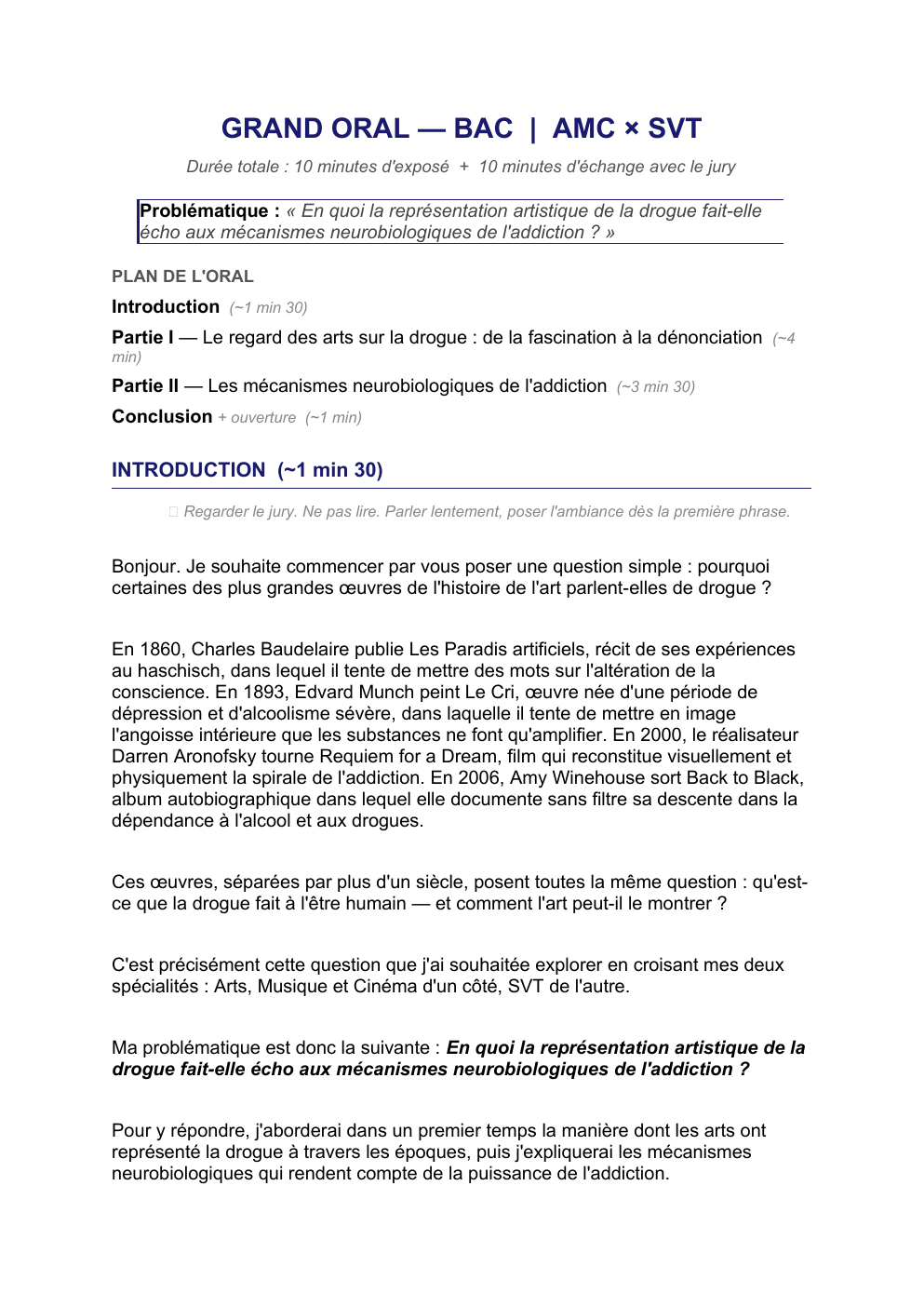
GRAND ORAL — BAC | AMC × SVT
Durée totale : 10 minutes d'exposé + 10 minutes d'échange avec le jury
Problématique : « En quoi la représentation artistique de la drogue fait-elle
écho aux mécanismes neurobiologiques de l'addiction ? »
PLAN DE L'ORAL
Introduction (~1 min 30)
Partie I — Le regard des arts sur la drogue : de la fascination à la dénonciation (~4
min)
Partie II — Les mécanismes neurobiologiques de l'addiction (~3 min 30)
Conclusion + ouverture (~1 min)
INTRODUCTION (~1 min 30)
⏱ Regarder le jury.
Ne pas lire.
Parler lentement, poser l'ambiance dès la première phrase.
Bonjour.
Je souhaite commencer par vous poser une question simple : pourquoi
certaines des plus grandes œuvres de l'histoire de l'art parlent-elles de drogue ?
En 1860, Charles Baudelaire publie Les Paradis artificiels, récit de ses expériences
au haschisch, dans lequel il tente de mettre des mots sur l'altération de la
conscience.
En 1893, Edvard Munch peint Le Cri, œuvre née d'une période de
dépression et d'alcoolisme sévère, dans laquelle il tente de mettre en image
l'angoisse intérieure que les substances ne font qu'amplifier.
En 2000, le réalisateur
Darren Aronofsky tourne Requiem for a Dream, film qui reconstitue visuellement et
physiquement la spirale de l'addiction.
En 2006, Amy Winehouse sort Back to Black,
album autobiographique dans lequel elle documente sans filtre sa descente dans la
dépendance à l'alcool et aux drogues.
Ces œuvres, séparées par plus d'un siècle, posent toutes la même question : qu'estce que la drogue fait à l'être humain — et comment l'art peut-il le montrer ?
C'est précisément cette question que j'ai souhaitée explorer en croisant mes deux
spécialités : Arts, Musique et Cinéma d'un côté, SVT de l'autre.
Ma problématique est donc la suivante : En quoi la représentation artistique de la
drogue fait-elle écho aux mécanismes neurobiologiques de l'addiction ?
Pour y répondre, j'aborderai dans un premier temps la manière dont les arts ont
représenté la drogue à travers les époques, puis j'expliquerai les mécanismes
neurobiologiques qui rendent compte de la puissance de l'addiction.
PART I — How the arts represent drugs (~4 min)
⏱ Speak in English for this entire part.
Rely on specific works — show the jury you truly know
them.
A.
Drugs as artistic material: a long tradition (~1 min 30)
Drugs have fascinated artists for centuries.
But it is in the 19th century, with the
Romantic movement, that they truly become a literary and visual subject in their own
right.
Charles Baudelaire, in Les Paradis artificiels (1860), describes his experiences with
hashish with an almost clinical precision.
He writes about a 'dilation of time' and
'synesthesias' where sounds become colours.
His writing attempts to capture what
ordinary consciousness cannot perceive.
For him, the drug is a tool for poetic
exploration — a way to reach what he calls an 'artificial ideal'.
In painting, Edvard Munch is a striking example of an artist whose work is directly
shaped by psychological suffering and addiction.
A severe alcoholic for much of his
life, he went through intense depressive episodes.
His painting The Scream (1893) is
widely interpreted as the representation of an acute anxiety crisis.
In his journals, he
wrote that he painted 'the screams of nature' that he heard during a walk.
Art
becomes here the only space to express what addiction and inner distress do to the
body and the mind.
This is not the glorification of a substance — it is the visible mark
it leaves behind.
Drugs are therefore represented in the arts very early on as a double-faced reality:
the promise of an extraordinary experience, and the risk of a downfall.
B.
Rock, television, music: glorification and romanticisation (~1 min)
This ambivalence runs throughout the 20th century, particularly in popular music and
visual storytelling.
1960s and 70s rock turned drugs into a symbol of rebellion, freedom and creativity.
Jimi Hendrix, Jim Morrison, Janis Joplin: they consumed openly, and their public
image was inseparable from this transgression.
Drugs almost became a condition of
artistic genius — a myth that would resurface later with the '27 Club', those artists
who died at 27 from overdose or addiction.
Breaking Bad (Vince Gilligan, 2008-2013) takes this logic even further.
The series
follows Walter White, a chemistry teacher who becomes a methamphetamine
manufacturer.
What is remarkable from an artistic standpoint is the way the series
uses chemistry itself as a visual language: the colours, the close-up shots of drug
crystals, the almost scientific precision of the production scenes.
The drug is not
merely a subject — it structures the entire visual grammar of the work.
And the
series shows with relentless progression how the production and consumption of
drugs gradually corrupts an ordinary man.
These works raise an important ethical question: by representing drugs with such
intensity and visual power, do they not contribute to normalising — or even
romanticising — them?
C.
Denunciation: when art tells the truth about addiction (~1 min 30)
Against this tradition of glorification, other artists have chosen to represent drugs
without romanticism — showing what they truly destroy.
Requiem for a Dream (Aronofsky, 2000) is probably the most radical example.
The
film follows four characters consumed by different addictions: heroin, amphetamines,
prescription drugs.
The filmmaking itself feels addictive: ultra-fast editing, fish-eye
lenses that distort reality, Clint Mansell's obsessive score that loops like a craving.
The audience does not watch addiction from the outside — they feel it.
It is a bold
artistic choice in service of a powerful preventive message.
Amy Winehouse represents another form of testimony.
Her album Back to Black
(2006) and her song Rehab — in which she refuses to enter a rehabilitation centre
— are autobiographical documents of brutal honesty.
The documentary Amy by Asif
Kapadia (2015), built from archive footage, shows how her addiction gradually
invaded her life and smothered her talent.
Art is no longer a staging of the drug: it is
the drug itself that ends up consuming the artist.
All these artistic representations — whether they fascinate or denounce — are
grounded in very real biological effects.
That is what I will now explain.
PARTIE II — La neurobiologie de l'addiction (~3 min 30)
⏱ Vocabulaire précis attendu : dopamine, circuit mésolimbique, synapse, neuroplasticité,
tolérance, sevrage.
A.
Le circuit de la récompense : pourquoi le cerveau « accroche » (~1 min 30)
Pour comprendre pourquoi la drogue est vécue comme une force aussi irrésistible —
et donc pourquoi les artistes la représentent souvent comme telle — il faut
comprendre ce qu'elle fait précisément au cerveau.
Toutes les substances addictives agissent sur ce qu'on appelle le circuit
mésolimbique de la récompense.
Ce circuit relie l'aire tegmentale ventrale (ATV)
au noyau accumbens, en passant par le cortex préfrontal.
Il utilise la dopamine
comme neurotransmetteur principal.
En conditions normales, ce circuit est activé par des comportements vitaux : manger,
socialiser, accomplir un objectif.
Il génère une sensation de plaisir et de satisfaction,
ce qui renforce ces comportements.
C'est un mécanisme de survie fondamental.
Les drogues détournent ce mécanisme.
Prenons l'exemple de la cocaïne : elle
bloque les transporteurs de recapture de la dopamine dans la fente synaptique.
Résultat : la dopamine s'accumule, le signal est amplifié de manière artificielle et
massive.
Le cerveau interprète cette inondation de dopamine comme un signal de
satisfaction extrême — bien au-delà de ce qu'un plaisir naturel peut produire.
L'euphorie ressentie peut être dix à vingt fois plus intense qu'un plaisir ordinaire.
Le problème est que le cerveau va mémoriser....
»
↓↓↓ APERÇU DU DOCUMENT ↓↓↓

Liens utiles
- Grand Oral – Svt Quels sont les conséquences de la prise d’un produit dopants sur l’organisme : exemple du Trenbolone
- Grand oral : comment les mathématiques ont elles permis à Michael Scofield de s'évader de river fox dans la série prison break
- Grand Oral: Le nombre d’or
- Grand oral hggsp les ZEE EN ARCTIQUE
- Ressources grand oral fast fashion